Can a disc bulge heal without surgery?
In many cases, yes. A disc bulge or lumbar disc herniation does not automatically mean that surgery is required.
Many people improve with non-surgical care that may include physical therapy, appropriate exercise, activity modification, pain management, and time. Research has also shown that some lumbar disc herniations can naturally shrink or regress over time. However, the likelihood of improvement depends on the type of disc problem, symptoms, neurological findings, and the individual’s overall condition.
This is why an MRI report should not be viewed in isolation.
A person may have a disc bulge on an MRI but experience little or no pain, while another person with a similar-looking MRI may have significant back pain, sciatica, numbness, or weakness.
The important question is not simply:
“Do I have a disc bulge?”
It is:
“Is the disc problem causing my symptoms, and what is the safest and most appropriate treatment for me?”
If you’re looking for disc bulge treatment in Lahore, disc bulge physiotherapy in Lahore, slipped disc treatment, or sciatica treatment, a professional physical therapy assessment can help determine whether conservative rehabilitation may be appropriate.

Prof. Dr. Hafiz Muhammad Asim, DPT (USA), OCS (USA) is a Consultant Physical Therapist with more than 27 years of clinical experience in orthopedic, musculoskeletal, neurological rehabilitation, and chronic pain management.
📍 153/1, Sector F, Phase V, DHA, Lahore
📞 0300-9400346 | 042-37178903
Book a Physical Therapy Consultation
What Is a Disc Bulge?
Between the bones of your spine are soft structures called intervertebral discs.
These discs help absorb forces and allow the spine to move.
A disc contains a softer inner portion surrounded by a tougher outer layer. With age, repetitive loading, injury, or degenerative changes, a disc can change shape.
One possible change is a disc bulge.
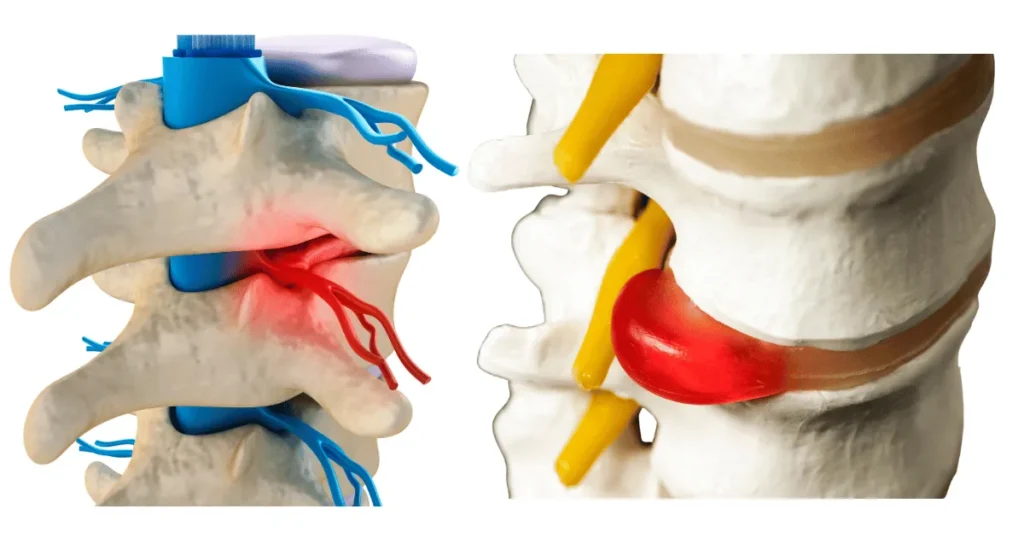
A disc bulge occurs when the disc extends beyond its normal boundary. Importantly, not every disc bulge causes symptoms.
Some people have disc bulges visible on MRI without experiencing significant back pain or neurological symptoms.
That’s why an MRI finding needs to be interpreted alongside the patient’s symptoms and physical examination.
Disc Bulge vs. Disc Herniation: Are They the Same?
The terms disc bulge, disc protrusion, disc extrusion, and disc herniation are sometimes used interchangeably by patients, but they are not necessarily identical.
Radiologists and spine specialists use specific terminology to describe different types of disc changes.
A broad disc bulge is different from a focal protrusion or extrusion.
This distinction matters because the natural history can differ between disc types.
Research has found that spontaneous regression is more commonly observed in extruded and sequestered disc herniations than in simple disc bulges. One systematic review reported regression probabilities of approximately 13% for bulging, 41% for protrusion, 70% for extrusion, and 96% for sequestration. A later meta-analysis found a similar pattern, with higher regression rates for extruded and sequestered discs.
These numbers should not be interpreted as a personal prediction for an individual patient.
Your symptoms, examination, imaging findings, and clinical history all matter.
Can a Disc Bulge Heal Naturally?
This is where the answer becomes more interesting.
A disc bulge may not always “heal” in the sense of returning exactly to its original shape.
However, symptoms can improve significantly, and some disc abnormalities can decrease in size over time.
Studies have documented spontaneous regression or resorption of lumbar disc herniation without surgery. A 2024 meta-analysis involving more than 2,200 patients reported an overall pooled disc-resorption incidence of about 70%, although the rate varied substantially according to the type of disc herniation.
Another meta-analysis of non-surgically treated symptomatic lumbar disc herniation found an overall regression rate of about 63%.
This means that surgery is not automatically necessary simply because an MRI shows a disc problem.
But there is an important distinction:
Disc healing and symptom improvement are not exactly the same thing.
You can feel much better even if the MRI still shows some disc changes.
Likewise, an MRI can show an abnormality even when it is not the main cause of your pain.
The goal of treatment is therefore not necessarily to “make the MRI normal.”
The goal is to help you:
- Reduce pain
- Improve movement
- Restore strength
- Improve function
- Return to normal activities
- Reduce disability
- Safely manage your condition
How Does a Disc Herniation Shrink Without Surgery?
Researchers believe several biological processes may contribute to spontaneous disc resorption.
When disc material moves outside its normal location, the body may recognize the displaced tissue as abnormal and initiate an inflammatory and immune response.
This can involve:
- Inflammatory processes
- New blood-vessel formation
- Macrophage activity
- Breakdown of disc material
- Gradual resorption of herniated tissue
The exact mechanisms are still being studied, but evidence supports the phenomenon of spontaneous regression.
Interestingly, larger or more exposed disc herniations may sometimes have a greater chance of regression than contained bulges because they have greater contact with surrounding tissues and blood supply.
Does Every Disc Bulge Need Treatment?
No.
Not every disc bulge causes symptoms.
Some people discover a disc bulge incidentally during an MRI performed for another reason.
This is why treatment should be based on the person, not just the scan.
A healthcare professional may consider:
- Your symptoms
- Pain location
- Duration of symptoms
- Neurological symptoms
- Muscle strength
- Sensation
- Reflexes
- Walking ability
- Functional limitations
- Previous injuries
- MRI findings
- Overall health
The same MRI finding can have very different significance in two different people.
What Symptoms Can a Disc Bulge Cause?
A disc problem can cause different symptoms depending on its location and whether it affects nearby nerves.
Common symptoms may include:
Lower Back Pain
Pain may be localized around the lower back and may vary with movement or activity.
Leg Pain or Sciatica
When a lumbar disc problem irritates a nerve root, pain may travel from the lower back into the buttock and leg.
This is commonly described as sciatica.
Numbness or Tingling
Some people experience altered sensation in the leg or foot.
Muscle Weakness
Nerve involvement can sometimes cause weakness in specific muscles.
Reduced Mobility
Pain and muscle guarding can make bending, walking, sitting, or other movements difficult.
Not everyone with a disc bulge experiences all of these symptoms.
Can Physiotherapy Treat a Disc Bulge?
Physical therapy can be an important component of non-surgical management for many people with low back pain and related conditions.
The treatment is not designed simply to “push the disc back into place.”
Instead, physical therapy focuses on improving the person’s symptoms, movement, strength, function, and ability to manage daily activities.
Depending on the patient’s condition, rehabilitation may include:
- Therapeutic exercises
- Strengthening exercises
- Mobility exercises
- Movement retraining
- Core and trunk conditioning
- Education about activity
- Gradual return to normal movement
- Manual therapy when appropriate
- Home exercise programs
The specific program should be individualized.
The World Health Organization recommends evidence-based non-surgical approaches for chronic primary low back pain, including education, physical interventions, psychological interventions, medicines, and multicomponent approaches depending on the individual situation.
What Does Physical Therapy for a Disc Bulge Involve?
A good rehabilitation program is more than a collection of random exercises from the internet.
1. Initial Assessment
The physical therapist reviews your symptoms and medical history and performs an appropriate physical assessment.
The therapist may evaluate:
- Spinal movement
- Strength
- Flexibility
- Neurological signs
- Walking
- Balance
- Functional movement
- Pain behavior
2. Identify Functional Problems
The goal is to understand what activities are currently limited.
For example:
“I can’t sit for more than 20 minutes.”
or:
“My leg hurts when I walk.”
or:
“I can’t bend forward without severe pain.”
These functional limitations become important rehabilitation targets.
3. Build a Personalized Exercise Program
Exercises may be selected according to the patient’s symptoms, physical findings, strength, mobility, and rehabilitation goals.
4. Gradually Increase Activity
Complete bed rest is generally not the long-term solution for most uncomplicated low back pain.
The goal is usually to gradually return to appropriate movement and daily activity.
5. Learn How to Manage Future Episodes
Education is an important part of rehabilitation.
Patients can learn how to:
- Manage symptoms
- Modify activities temporarily
- Progress exercises
- Improve physical capacity
- Return to exercise safely
- Recognize warning signs
What Exercises Are Good for a Disc Bulge?
There is no single exercise that is best for every disc bulge.
This is one of the most important things to understand.
An exercise that helps one person may aggravate another person’s symptoms.
Depending on the individual, a physical therapist may prescribe exercises involving:
Core strengthening
Improving trunk strength and endurance may help support functional movement.
Hip strengthening
Hip strength can be important for walking, lifting, stairs, and other activities.
Mobility exercises
Appropriate mobility work can help restore comfortable movement.
Movement-control exercises
These exercises help patients develop better control during functional movements.
Walking and aerobic activity
Appropriate activity can support general physical conditioning and recovery.
The right exercise depends on the patient’s assessment.
Do not copy a disc-bulge exercise program from social media simply because it worked for someone else.
Should You Rest if You Have a Disc Bulge?
Rest can sometimes be helpful during a painful flare-up, but prolonged inactivity can lead to deconditioning and may make returning to normal activity more difficult.
For most people with uncomplicated low back pain, the long-term goal is to return gradually to appropriate movement and normal activities.
The amount and type of activity should depend on your symptoms.
A physical therapist can help you determine:
- What movements are safe
- What activities should temporarily be modified
- How much walking is appropriate
- When to begin strengthening
- How to progress activity
Can You Exercise With a Disc Bulge?
In many cases, yes.
Having a disc bulge does not necessarily mean that you must stop exercising permanently.
The important issue is choosing appropriate exercises and progressing them gradually.
Depending on your condition, rehabilitation may eventually include:
- Walking
- Strength training
- Core exercises
- Hip strengthening
- Flexibility work
- Functional exercises
- Sport-specific training
If exercise consistently causes worsening symptoms, especially neurological symptoms, you should stop and seek professional assessment.
Can a Disc Bulge Get Worse?
Disc symptoms can fluctuate.
Pain may improve and then temporarily return after increased activity, poor sleep, stress, prolonged sitting, or other factors.
A temporary increase in pain does not necessarily mean that the disc has become structurally worse.
However, new or progressive neurological symptoms should be taken seriously.
In particular, increasing muscle weakness requires prompt medical assessment.
When Is Surgery Needed for a Disc Bulge?
This is one of the most important questions.
Surgery is not automatically required for every disc bulge.
However, surgery may be considered when symptoms are severe, persistent, disabling, or associated with significant neurological problems, depending on the individual clinical situation.
The decision should be made by an appropriately qualified spine or surgical specialist after reviewing the patient’s symptoms, examination, imaging, and response to conservative treatment.
The key point is:
“No surgery” should never mean “no medical assessment.”
When Should You Seek Urgent Medical Attention?
Some symptoms require urgent assessment.
Seek urgent medical attention if you develop symptoms such as:
- New or rapidly worsening leg weakness
- Significant difficulty walking
- Loss of bladder control
- New loss of bowel control
- Numbness around the inner thighs, buttocks, or genital region
- Severe neurological changes
These symptoms can indicate serious nerve compression, including possible cauda equina syndrome, and should not be managed with routine home exercises alone.
If you experience these symptoms, seek urgent medical care rather than waiting for a physical therapy appointment.
Does a Disc Bulge Always Cause Sciatica?
No.
A disc bulge can exist without causing sciatica.
Sciatica generally refers to pain following the distribution of the sciatic nerve, usually associated with irritation or compression of lumbar nerve roots.
Some people have:
Disc bulge + no symptoms
Others may have:
Disc bulge + back pain
And others:
Disc herniation + nerve irritation + leg pain/sciatica
This is why an MRI report should always be interpreted in the context of the clinical examination.
Why Your MRI Doesn’t Tell the Whole Story
MRI is an important diagnostic tool, but imaging findings do not always correspond perfectly with pain.
Disc degeneration, bulging discs, and other spinal changes can be seen in people who have no significant symptoms.
This creates an important distinction:
MRI finding ≠ automatic diagnosis of the cause of pain
A good clinical assessment combines:
History + Physical Examination + Imaging When Appropriate
rather than relying on the MRI alone.
How Long Does It Take for a Disc Bulge to Improve?
There is no single recovery timeline.
Some people improve over several weeks.
Others require several months of rehabilitation.
The timeline can depend on:
- Type of disc problem
- Severity of symptoms
- Nerve involvement
- Physical activity
- General health
- Previous episodes
- Rehabilitation
- Work demands
- Sleep and stress
- Other medical conditions
Research on spontaneous disc resorption suggests that structural changes can continue over months, and a 2024 meta-analysis reported that resorption commonly occurred during the first six months in the included studies.
But remember:
You do not need to wait for the MRI to become normal before you can feel better.
Clinical improvement can occur before complete radiological resolution.
Can a Disc Bulge Return After Treatment?
It is possible for back pain or disc-related symptoms to return.
Having one episode does not mean that you will never experience another.
This is why rehabilitation should ideally include more than short-term pain relief.
A long-term program may focus on:
- Strength
- Mobility
- Physical conditioning
- Healthy movement
- Activity tolerance
- Work ergonomics
- Exercise habits
- Weight management where appropriate
- Understanding symptom triggers
The objective is to help you build a body that is better prepared for everyday demands.
Common Mistakes People Make After a Disc Bulge Diagnosis
Mistake 1: Assuming Surgery Is Inevitable
An MRI showing a disc bulge does not automatically mean surgery.
Many people improve with conservative care.
Mistake 2: Staying in Bed for Too Long
Extended inactivity can contribute to weakness and reduced physical capacity.
Mistake 3: Doing Random Exercises
Not every exercise is appropriate for every condition.
Mistake 4: Ignoring Neurological Symptoms
Weakness, significant numbness, or changes in bladder or bowel function require appropriate medical attention.
Mistake 5: Treating the MRI Instead of the Person
Your symptoms and functional limitations matter as much as the scan.
Mistake 6: Expecting Immediate Results
Rehabilitation is usually a gradual process.
Disc Bulge Treatment in Lahore
If you are searching for disc bulge treatment in Lahore, disc bulge physiotherapy in Lahore, slipped disc treatment in Lahore, or sciatica physiotherapy in Lahore, the first step should be a proper assessment.
Prof. Dr. Hafiz Muhammad Asim is a Consultant Physical Therapist with more than 27 years of experience in:
- Musculoskeletal rehabilitation
- Orthopedic physical therapy
- Chronic pain management
- Neurological rehabilitation
- Post-surgical rehabilitation
- Therapeutic exercise
- Manual therapy
He holds a Doctor of Physical Therapy (DPT) from A.T. Still University, Arizona, USA, and is an Orthopedic Certified Specialist (OCS).
His practice is located in:
153/1, Sector F, Phase V, DHA, Lahore
Book a Consultation
📞 0300-9400346
📞 042-37178903
Book an Appointment on WhatsApp
Frequently Asked Questions
The Bottom Line: Does a Disc Bulge Mean You Need Surgery?
Not necessarily.
A disc bulge or lumbar disc herniation can sometimes improve with non-surgical treatment, and research has demonstrated that disc herniations can spontaneously shrink or regress.
But recovery is not about the MRI alone.
The right question is:
What is causing your symptoms, how is it affecting your function, and what treatment is appropriate for your specific condition?
For many patients, a structured rehabilitation program can be an important part of recovery.
If you have persistent back pain, sciatica, or symptoms associated with a disc problem, consider getting a professional assessment rather than relying solely on an MRI report or internet exercises.
Physical Therapy Consultation in DHA Phase 5, Lahore
Prof. Dr. Hafiz Muhammad Asim, DPT (USA), OCS (USA)
Consultant Physical Therapist
📍 153/1, Sector F, Phase V, DHA, Lahore
📞 0300-9400346 | 042-37178903
This article is for general educational purposes and does not replace a medical diagnosis or individualized treatment plan. Disc-related symptoms can have different causes. Seek urgent medical care for new or worsening weakness, loss of bladder or bowel control, numbness around the saddle/groin area, or other severe neurological symp